RECIPE DETAILS
Item ID: 1957738
Serving Size: 1 Wrap
HACCP Process Category:
#2 - Same Day Service
Food Category: Lunch Entree
Attributes: Vegetarian, Sandwich, Wraps, Beans, Peas, Lentils
Allergens: Wheat, Sesame
RECIPE DETAILS
Item ID: 1957738
Serving Size: 1 Wrap
HACCP Process Category:
#2 - Same Day Service
Food Category: Lunch Entree
Attributes: Vegetarian, Sandwich, Wraps, Beans, Peas, Lentils
Allergens: Wheat, Sesame
Ingredients
To scale a recipe, change the “Standard Yield” number, then click the “Scale” button. We recommend scaling based on multiples of servings per pan. Click the “Reset” button to return to the default standard batch size.
Ingredients list for this recipe is unavailable.
Ingredients used in the recipes are commonly found USDA Foods or commercially available products. All ingredients for each recipe are listed in “As purchased” quantities. Ingredient yields from USDA’s Food Buying Guide can be found at the top of the Recipe Instructions when applicable.
Instructions
Yields
- Garlic: 50% (whole, roasted)
- Garbanzo Beans (Chickpeas), canned: 65% (drained)
- Cucumber: 98%
- Cherry Tomatoes: 95%
- Avocado: 67%
Pre-Preparation
-
Make Hummus:
- Drain the garbanzo beans (first amount) for 3 hours before using. Reserve the bean liquid.
- Cut garlic bulbs in half across the equator, then wrap in foil and roast in a 350°F oven for about 1 hour.
- Once cooled, peel the garlic cloves and save the garlic oil.
- Combine the garbanzo beans, roasted garlic, oil, lemon juice, tahini, salt, and bean liquid in a container.
- Blend with an immersion blender, blender, or food processor until smooth.
- Cover and hold cold until service at 41°F or less.
- Drain the garbanzo beans (second amount).
-
Prep vegetables:
- Wash produce as needed.
- Slice ends off cucumbers, then cut into 1/8-inch thick round slices.
- Halve cherry tomatoes.
- Halve the avocados, then remove the pit, cut into 1/8-inch slices and scoop out the avocado.
Preparation
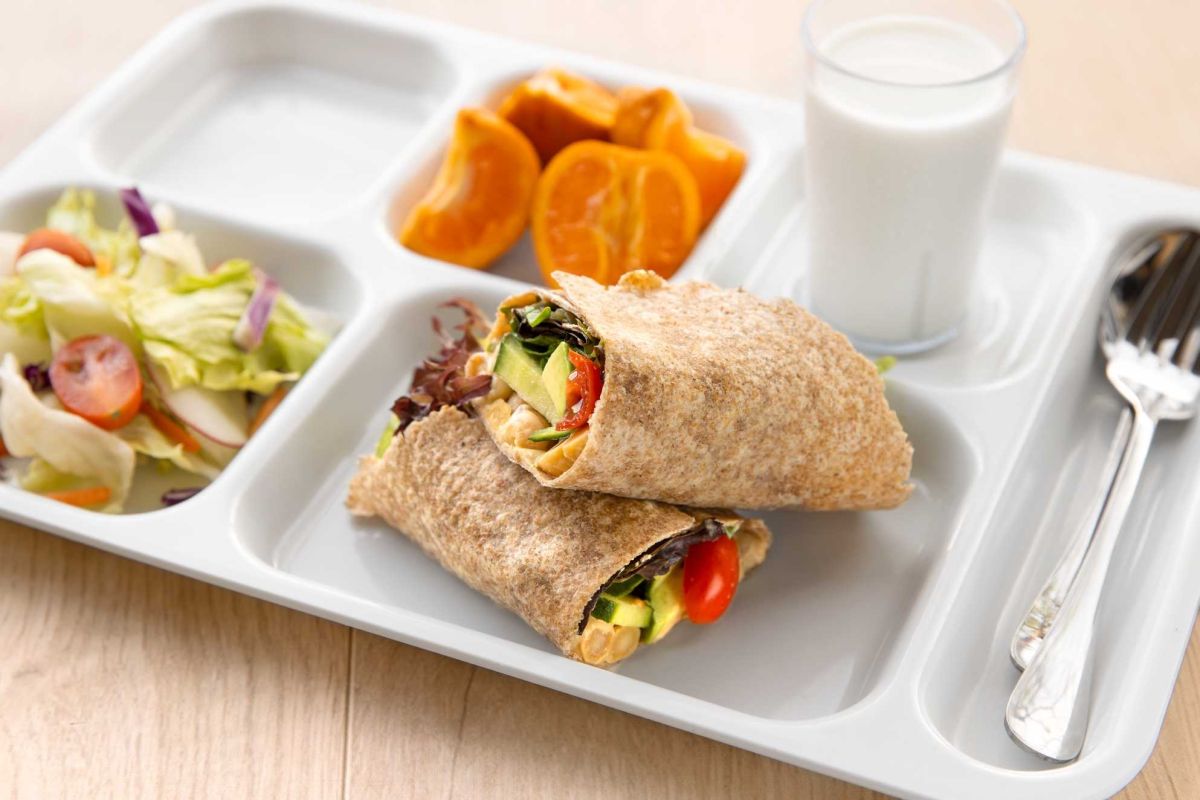
Assemble wraps in an assembly line:
- Lay tortillas out over the whole prep table.
- For each tortilla:
- Spread 3 oz hummus in the center of each 9-inch tortilla.
- Sprinkle 3 oz drained garbanzo beans over the hummus.
- Arrange a row of cucumbers, tomatoes, and avocado down the center.
- Cover with 1/2 cup spring mix.
- Fold the sides inward over the filling.
- Pull the bottom edge over the filling to start the roll.
- Tighten the filling by gently pulling back with your fingertips, then continue rolling.
- Roll to the top edge to seal, ending with the seam side down.
- Slice each wrap in half down the middle or slightly diagonal on a bias.
- Hold cold until service at or below 41°F.
Serving
Serving size: 1 wrap
Recipe Source
CIA Healthy Kids Collaborative
We recommend that any recipe selected for use in your district be tested in your kitchens before adding it to your menu. Recipe testing ensures that the methods and yields are compatible when prepared with your equipment. Since seasonings are particularly affected by scaling recipes, we highly recommend taste testing as you adjust quantities.
Food Groups/Meal Patterns
Based on default serving size and measure.
| Meal Pattern | Amount Per Serving |
|---|---|
| Fruits | 0 cups |
| Vegetables, Dark Green | 0 cups |
| Vegetables, Red/Orange | ⅛ cups |
| Vegetables, Beans, Peas, & Lentils | 0 cups |
| Vegetables, Starchy | 0 cups |
| Vegetables, Other | ⅛ cups |
| Vegetables, Additional | ¼ cups |
| Grains | 2 oz eq |
| Meat/Meat Alternatives | 2.25 oz eq |
| Fluid Milk | 0 cups |
Nutrition Facts
Based on default serving size and measure.
| Nutrients | Serving |
|---|---|
| Calories | 428.58* kcal |
| Total Fat | 19.42* gm |
| Saturated Fat | 3.64* gm |
| Trans Fat | 0.00* gm |
| Sodium | 765.95* mg |
| Carbohydrates | 52.49* gm |
| Fiber | 13.92* gm |
| Sugars | 2.50* gm |
| Added Sugars | 0.00* gm |
Discover More
Menu Development
When we change from ready-to-heat foods to fresh foods in the context of menu planning, letting go of prior presumptions is important. Determining the amount of choices and how many per each age group are examples of menu planning challenges. Efficient, fiscally sustainable scratch-cooking programs are reducing choices in favor of fresh flavors.