RECIPE DETAILS
Item ID: 1973247
Serving Size: 1 Piece (8.24 oz)
HACCP Process Category:
#3 - Complex Food Preparation
Food Category: Lunch Entree
Attributes: None
Allergens: Milk, Wheat
RECIPE DETAILS
Item ID: 1973247
Serving Size: 1 Piece (8.24 oz)
HACCP Process Category:
#3 - Complex Food Preparation
Food Category: Lunch Entree
Attributes: None
Allergens: Milk, Wheat
Ingredients
To scale a recipe, change the “Standard Yield” number, then click the “Scale” button. We recommend scaling based on multiples of servings per pan. Click the “Reset” button to return to the default standard batch size.
Ingredients list for this recipe is unavailable.
Ingredients used in the recipes are commonly found USDA Foods or commercially available products. All ingredients for each recipe are listed in “As purchased” quantities. Ingredient yields from USDA’s Food Buying Guide can be found at the top of the Recipe Instructions when applicable.
Instructions
Yields
- Ground Beef 85/15: 75% (cooked and drained)
- Onion: 78%
- Bell pepper: 73%
- Mushrooms: 43%
- Zucchini: 86%
- Broccoli: 81%
Pre-Preparation
- Wash produce as needed.
- Cut off ends and remove skin from onions, then dice into small cubes.
- Remove stems and seeds from bell peppers, then dice into small cubes.
- Slice the top end off the zucchini, then dice into small cubes.
- Thinly slice mushrooms.
- Cut broccoli into small florets.
- Mince garlic.
- Preheat the oven to 375°F.
Preparation
Cook the beef:
- In a pan or tilt skillet set over medium-high heat, cook the ground beef while breaking apart with a bench scraper or metal spatula until the internal temperature reaches 155°F.
- Drain excess fat and set aside.
- If using another day, cool properly according to HACCP procedures: chill to 70°F within 2 hours and to 41°F or less within 4 hours.
Prepare the tomato sauce:
- In a large stockpot set over medium-low heat, warm the oil (first amount) and cook onions for about 2-3 minutes until softened and translucent.
- Add bell peppers, garlic, red pepper flakes, and cook for about 2-3 minutes until the peppers have slightly softened.
- Stir in tomato paste.
- Add tomato sauce, dried basil, dried oregano, salt (first amount), and black pepper (second amount).
- Bring to a simmer for about 30 minutes to reduce the volume of sauce; stir occasionally.
- Blend with an immersion blender until smooth. Adjust by adding a little water if needed to thin out the sauce slightly.
- If using another day, cool properly according to HACCP procedures: chill to 70°F within 2 hours and to 41°F or less within 4 hours.
Prepare the cheese filling:
- Mix 6 cups of mozzarella and 2.5 cups of parmesan per hotel pan for the cheese topping, then set aside.
- In a container, mix together the remaining mozzarella and parmesan cheeses with the cottage cheese, parsley, granulated garlic, and black pepper (second amount).
- If using another day, cover, label, date, and refrigerate at or below 41°F.
Prepare the vegetable medley:
- In a pan or tilt skillet set over medium heat, warm the oil (second amount).
- Cook mushrooms for about 3-5 minutes until browned and the moisture has cooked off.
- Add zucchini and cook for about 5 minutes until the edges are lightly browned.
- Add broccoli florets and cook for about 2 minutes.
- Add salt (second amount) and stir the vegetables together.
- Remove from heat.
Assemble in each 2-inch hotel pan: (bottom to top, about 12.36 lbs per pan)
- 1 cup tomato sauce spread thinly over the bottom of each pan.
- 2 half sheets of pre-cooked lasagna noodles (press into sauce leaving small gaps between sheets).
- 3 1/4 cups cheese mixture
- 2 cups cooked ground beef
- 4 cups vegetable medley
- 3 cups tomato sauce spread evenly
- 2 half sheets of pre-cooked lasagna noodles
- 3 1/4 cups cheese mixture
- 2 half sheets of pre-cooked lasagna noodles
- 2 cups tomato sauce spread evenly
- 2 cups cheese topping mixture
Bake Lasagna:
- Cover pans with greased parchment paper, then foil.
- Bake in 375°F oven for about 45 minutes or until the lasagna noodles are fully cooked and the internal temperature reaches 165°F.
- Uncover and bake for an additional 5 minutes or until the cheese is browned.
- Rest for 5-10 minutes before cutting.
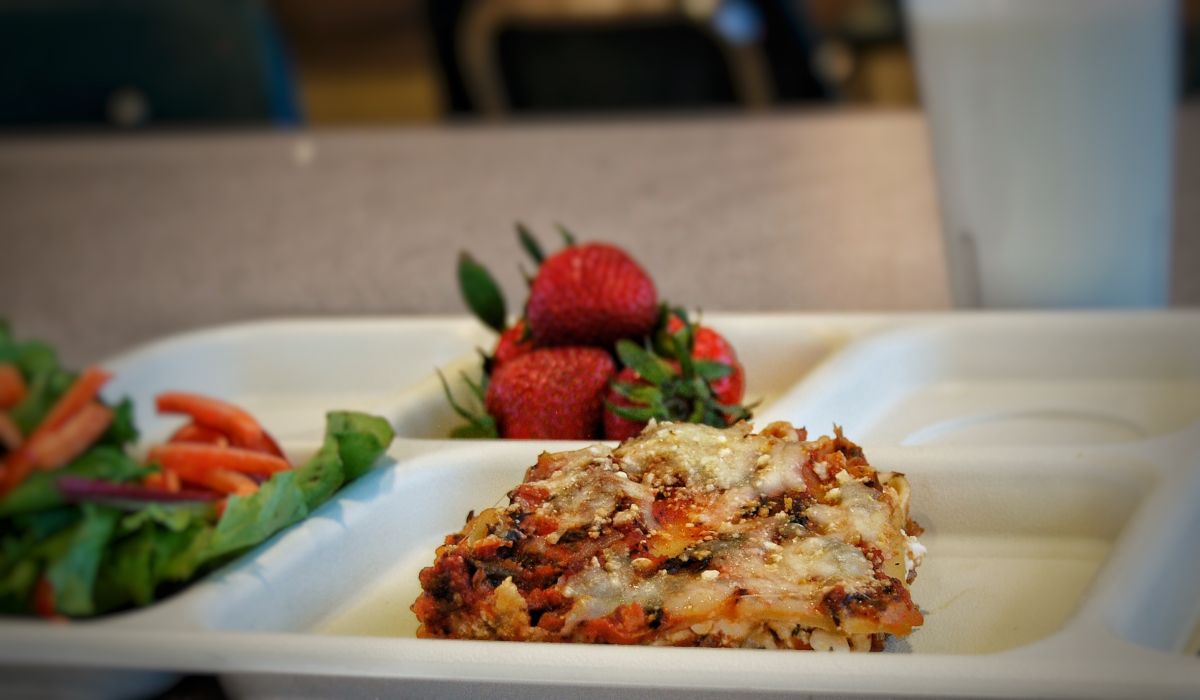
- Cut each pan into 24 squares (6 x 4).
- Hold hot until service at or above 135°F.
Serving
Serving size: 1 piece (8.24 oz)
Servings per pan: 24
Suggested serving utensil: spatula
Recipe Source
Live Well
We recommend that any recipe selected for use in your district be tested in your kitchens before adding it to your menu. Recipe testing ensures that the methods and yields are compatible when prepared with your equipment. Since seasonings are particularly affected by scaling recipes, we highly recommend taste testing as you adjust quantities.
Food Groups/Meal Patterns
Based on default serving size and measure.
| Meal Pattern | Amount Per Serving |
|---|---|
| Fruits | 0 cups |
| Vegetables, Dark Green | 0 cups |
| Vegetables, Red/Orange | ⅜ cups |
| Vegetables, Beans, Peas, & Lentils | 0 cups |
| Vegetables, Starchy | 0 cups |
| Vegetables, Other | ⅛ cups |
| Vegetables, Additional | ⅛ cups |
| Grains | 1 oz eq |
| Meat/Meat Alternatives | 2.5 oz eq |
| Fluid Milk | 0 cups |
Nutrition Facts
Based on default serving size and measure.
| Nutrients | Serving |
|---|---|
| Calories | 357.05 kcal |
| Total Fat | 14.34 gm |
| Saturated Fat | 6.61 gm |
| Trans Fat | 0.35* gm |
| Sodium | 443.86 mg |
| Carbohydrates | 31.70 gm |
| Fiber | 4.25 gm |
| Sugars | 6.87 gm |
| Added Sugars | 0.00* gm |
Discover More
Menu Development
When we change from ready-to-heat foods to fresh foods in the context of menu planning, letting go of prior presumptions is important. Determining the amount of choices and how many per each age group are examples of menu planning challenges. Efficient, fiscally sustainable scratch-cooking programs are reducing choices in favor of fresh flavors.